

Trackmen Talk with Dylan Beirne of the 15th Club
- trackmengolf

- May 2, 2020
- 11 min read
Updated: May 3, 2020
Dylan Beirne (dylan_beirne) is a senior data analyst with golf analytics company the 15th Club, who are changing the landscape for how we view and think about golf. They now form a central part of a number of high-profile European Tour professionals backroom teams, helping them identify weaknesses in their games as well as planning course strategies. More recently, they combined with the European team to help regain the Ryder Cup at Le Golf Nationale in Paris in 2018. We covered all of these topics and more with Dylan when we sat down (virtually) with him last week. Thanks to Dylan for being so generous with his time and we hope you enjoy some of the fantastic insights he provided!
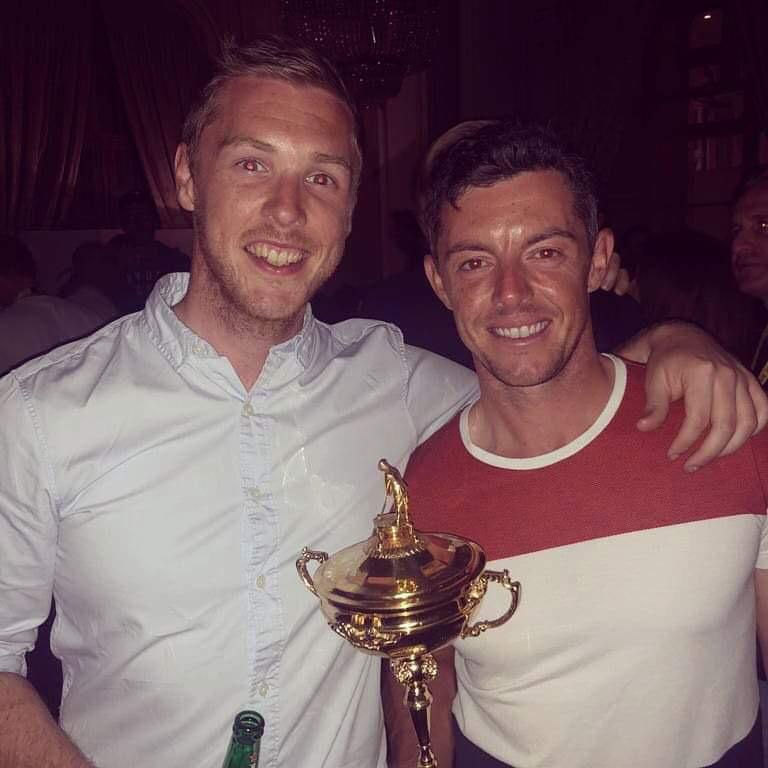
Pictured here is Dylan Beirne with Rory McIlory and the Ryder Cup, the night of Europe's famous win
Q. Tell us about what attracted you to join the 15th Club in the first place and the kind of insights you look to provide to golf enthusiasts from data that has not been available previously?
I had kind of always had an interest in using data to answer questions, I actually initially learned some data analysis languages just out of interest to try to get answers to some questions I had on scoring streaks in football. Being a golfer and a big fan of the game I ended up applying some of these things to personal projects in golf, and often had discussions about things like “do leaders close out leads better on easy courses or hard courses?”, and would always enjoy finding answers to that kind of thing. When I saw the opportunity with 15th Club then to apply these skills full time and on a bigger scale I was naturally very keen!
I think in terms of the insights I look to provide to golf enthusiasts, that would probably align fairly closely with my original approach, in that I like looking for answers to questions that people might not know. In both the media work that I do and some social media stuff, I always try to share things that I think will either help people understand the game, or just maybe surprise them a little bit. I think going forward I might try to include more win probability stuff as that’s often useful for people.
Q. You work with a number of tour professionals on a regular basis including Rory McIlory, Matt Fitzpatrick and Justin Rose to name just a few. What type of information do you look to provide them with to give them an edge over their competitors?
It actually varies quite a lot between players and their teams, but as a basis through the year we work with them on event scheduling advice and reports, regular performance reports (example below of a page from the approach section) and updates of their game, and a course report (example from Sawgrass this year below) for most courses each week.
Then depending on the player we can have specific questions, things like “I used this putter for events A,B and C, and then this other putter for events X,Y and Z, which one looks like I performed better”, and we can use a few different metrics and adjustments and give a summary of performance and maybe a recommendation. Quite often when I look at the numbers it seems like some of these things are tiny margins, but when we consider the really fine margins that exist at the top end of the game, it can be quite significant. For example, if the difference in a putter is the difference between holing a 5ft putt or missing it in each round, that’s about the difference between being ranked 100th in the world and being 50th. That’s also a really important part of the job, ensuring the information we deliver is understandable and actionable for players, because quite often saying “you’ll gain an extra 0.2 strokes per round doing this” probably won’t give them the full picture.


Q. It has since emerged after the Ryder Cup in Paris that the 15th Club played a vital role in planning Europe’s victory over the USA, with captain Thomas Bjorn eager to give you guys credit for helping them regain the trophy. What kind of advice did you offer to him in the lead up to the event?
There were a few stages of the process really. In the early stages it was centred around giving the captains a clear picture of who’s doing what, who’s playing well and why.
The main body of the work is done in the couple of months leading into the event, so for the wildcard picking process we’re essentially putting forward research and analysis that we’ve done on each of the potential picks, how they’ve performed, some elements of their history at the course and in the Ryder Cup, and who they could be paired with. We’re essentially trying to give the captains the best possible information to assist them in making the best possible decision. Once that’s finalised we move into the pairings process, which is somewhat similar. We’ve got a large body of research on players and pairings strategies, so we aim to summarise that and put forward our selection of the best data centred suggestions. There’s obviously a variety of other factors that go into a pairing, so at this stage there’s a lot of communication between us, the captains and the players in order to establish what will work best. The final stage is obviously being on site for the event. The majority of the plans are in place at this stage, but we monitor player performance over the week and feed that back to the captains. Fatigue and form can often be key factors for players at these team events, so having alternative plans and information to hand is key during the week to aid with some live decisions, particularly at the Ryder Cup where pairings are often submitted before the end of the previous session.
Q. Being inside the ropes and team room each day must have been an incredible experience. What was your favourite memory from the three days?
Absolutely, it was an incredible week all round. A personal highlight was just after the cup was clinched on 16, Rory came over to a couple of us and thanked us for the work we had put in and helping with the win. For obvious reasons I’ve always been a huge fan of Rory, but I thought that spoke volumes about him as a person and really made us feel that we had contributed somewhat to the success, so that was really nice.
Q. Following on from that success, you were asked to help out with the International team’s planning for the President’s Cup in Royal Melbourne in December. How did the planning for that event differ from what you had experienced with the Ryder Cup?
Ernie was trying to refresh the approach of the International team across the board, and we came in to help the team as a part of that. I think the players and the overall team behind the scenes had some more visibility of us personally and the work we were doing, which was ultimately a really good thing I think, as we got a lot of feedback from the players that they enjoyed the sense of structure and clarity it brought to the process. We also had to adapt to the live process of pairing selection, where obviously we could use the additional information to our advantage in places. Once the pairings had been finalised we worked out a system with the captains to optimise the picks live on stage in the moment, which actually played out really well in practice. On site we worked in a similar way, where we advised on some live changes due to a variety of reasons.

Dylan in deep discussion with Ernie Els in preparation for the afternoon pairing announcements
Q. It could be argued that your achievement in helping them get within two points of an American team that would have been perceived as vastly superior based on world ranking positions actually usurped that of helping Europe win the Ryder Cup, but is there anything you would have done differently in hindsight that could have overturned that deficit?
No doubt on paper the general thinking was that the US team were much stronger, but I think a lot of what Ernie put in place had a huge effect in closing that gap. He created an incredible team environment throughout the preceding two years, particularly for the players but also for the backroom team and everyone involved. This really set the players up to play their best, which is obviously the main factor, but also put gave our strategies the best chance to work out. Looking back I’d like to think we had a positive effect on the whole, and having thought about it a lot in the aftermath we didn’t really see anything we would have done differently overall to be honest, which I suppose is all we could aim for. The whole event I think came down to a couple of putts that dropped for the US team on Friday and Saturday, which in another situation wouldn’t drop and the conversation would likely be different.

The 15th Club team in discussion with Ernie Els and vice-captain Trevor Immelman at Royal Melbourne
Q. One of the biggest recent developments in golf statistics has been the creation of strokes gained categories that give us a clearer picture of how well a player is performing relative to the tour average. How important are strokes gained to you in providing data visualisations which really emphasise how well or badly a player is playing in different areas that isn’t displayed in their final score?
It’s really central to a lot of what we communicate to players. The ability to take things back to a single metric is hugely important to help give context to things. There are still a lot of complexities around the strokes gained metrics that are yet to be fully worked out and still need to be managed (like sample sizes, specific lies etc), but being able to pinpoint specific areas of a players game and give a clear picture of the effect it has is vital. It also gives us the opportunity to take it a step further and use the strokes gained metrics to calculate a ranking change or earnings change to really bring things to life for a player.
Q. I saw you recently posted a graphic on Twitter of Shane Lowry’s underlying performance in comparison to his actual results in the 18 months leading up to his Open victory that showed how well he was playing without shooting the scores to back it up. Can you give us an example of a player to watch this season (whenever it resumes!) who has been playing better than his results have suggested and could be set for a big year?
Generally these tend to be players who have a lot of steady performances but relatively few wins or top 5s, so they don’t appear on peoples radar or rise much in the world rankings. I’ll give a player from each side of the Atlantic for balance, so before the break Matthias Schwab was ranked 39th in our ratings (up there with Bezuidenhout, Garcia etc), but 82nd in OWGR. I’d expect him to have a win relatively soon and break into the top 50 by the end of the year.
On the PGA Tour, there’s a Korn Ferry graduate that some (shrewd) people will be familiar with in Matthew NeSmith. We rank him 95th in our ratings at the minute (up with Denny McCarthy, Kurt Kitayama, Charles Howell etc), but outside top 200 in OWGR. Similarly I’d expect some good finishes from him whenever we get back to play, and a steady rise up the rankings.
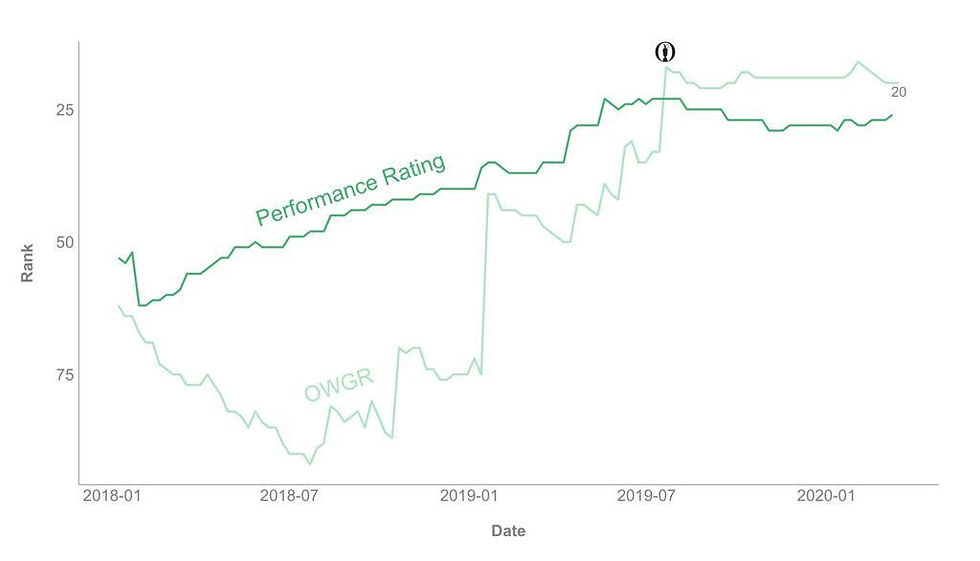
Graphic showing how Shane Lowry performed consistently throughout 2018 with the results not shining through until 2019
Q. Your colleague Justin Ray recently produced a piece on some of the greats to have played the game’s most untouchable records, such as Tiger winning four straight majors and producing the longest stretch of consecutive weeks as world no.1 by over twice as many as his nearest competitor. Have you come across any incredible statistical achievement in golf that doesn’t get the credit it deserves?
I think Justin has the monopoly on finding amazing stats to be fair, but it might actually have been Mark Broadie that discovered this one. Tiger beating the field average in 89 consecutive rounds is staggering to me. Anyone who plays or watches golf will appreciate how variable the game is, and for someone to display that level of consistent excellence over that period can’t be overstated as an achievement. As a reference for this, Tiger would have been around 3.5-4 strokes per round better than the field average at the time, so to take it to an amateur comparison, it’s like someone off 6 playing a round every week for over 18 months and not shooting worse than 9 over (granted, amateur players are more variable than pros but you get the idea!). I did a bit of analysis and came up with an estimate that a top player would be somewhere around 300000/1 to do that now, which gives a sense of how remarkable that is.
Q. All of us amateurs at home often marvel at the skills of the pros and regularly wonder why they are so much better than us. Which area of the game has the biggest gap between what the average pro can produce versus the average amateur?
If I had to pick one area I think driving would be the difference, partly in distance but it’s really the combination of distance, accuracy and a really low % of bad drives. Distance wise there are lots of amateurs playing of all sorts of handicaps that can hit a ball 280yds in warm weather with hard ground, but the issue is that they can’t find the fairway 60% of the time, and cant limit lost balls to one every 3-4 rounds.
The consistency of their driving, and their all round game is ultimately the biggest different in my eyes. For example in the short game I often look at shots they play and think I could have done it just as well (bear with me here!), but the key is that they do it well all the time, where if I had 10 balls to chip I might put 3 to 3ft, 3 to 6ft and 4 to 10ft, they’ll hit 5 to 3ft and 5 to 5ft. That’s apparent across their entire games, and that’s what makes them brilliant.
Q. Finally, a lot of us at home are sick to death of hearing people around our local club ramble out old golf sayings such as “drive for show, putt for dough” which, thanks to insights provided by the likes of you guys at the 15th Club, we now know have zero statistical basis. What golfing cliché do you hate hearing the most and is there an area of the game an amateur should look to focus on if they are trying to shave a few shots off their handicap?
I definitely am not a fan of the drive for show one alright, but another one might be the importance of wedges. Pros (and commentators) love to talk about how important shots from 80-120yds are, but in reality they make up a very small % of players actual approach shots, and really don’t have that much of an impact on scoring. Most pros would be far better served working on 125-175yds instead (assuming they’re not too bad with wedges).
For amateurs, driving is certainly as important if not more important than putting in terms of scoring. If someone misses 4 putts of 18 inches in a round everyone would write off their putting as the biggest issue in their game, but if they lose two balls off the tee it’s the same effect and often goes unnoticed.
Generally I think the requirements vary from player to player and at different levels, and I’d definitely encourage any serious amateurs to track their stats in some shape or form at least and work on it from there, but as a rule adding distance and maintaining accuracy would be where I’d focus. Improving quality off the tee is by far the most repeatable and consistent area of the game for the majority of players. I went through a process from around 18 months ago of trying to improve my driving distance and accuracy, and its significantly improved my scoring and consistency overall. I’ve just got a set of speed stick weights to try to add a bit more distance now, but will be closely monitoring my accuracy and % of poor drives alongside it to make sure I’m not dipping in those areas, because as I mentioned before, it’s those three together that are key.
Getting to Know Dylan Beirne
Current handicap?
3
Favourite club in the bag?
Driver
Home course?
Carrick-on-Shannon
If you could play any course in the world when lockdown ended, what would it be?
If I could play anywhere, Royal Melbourne. In reality, it’ll probably be Royal Carrick on Shannon!
Favourite golfer?
Really enjoy working with Fitz, but it’s probably Ernie or Rory.
Parkland or links?
Parkland all day!
Pint of choice in the clubhouse after a round?
Rockshore cider was a big hit in the golf club last summer so hopefully we’ll be able to sample some of that this year at some point.


India Lottery Khel Raja is your trusted destination for India Lottery games online. We provide a fantastic selection of money-making opportunities, all backed by a commitment to the best gaming experience, security, and fair play. From daily draws to bumper jackpots, we offer Indian players the chance to win big from the comfort of their home. Play with confidence on the nation's favorite online platform.